The 4Ps of Marketing: Why Great Marketing Starts Before the Ad
Most businesses think about marketing too late.
They build a product, decide what to charge, choose where to sell it, and eventually arrive at one question:
How do we promote this?
Then marketing is expected to make everything work.
Run more ads.
Create more content.
Launch another campaign.
Change the creative.
Offer a discount.
Increase the budget.
But Promotion is only one part of marketing.
One of the oldest marketing frameworks still explains this remarkably well:
Product. Price. Place. Promotion.
The 4Ps of marketing.
The problem is that the 4Ps have become so familiar that they are often treated like four boxes that need to appear somewhere inside a marketing strategy.
Product? Check.
Price? Check.
Place? Check.
Promotion? Check.
That misses the point.
The real value of the 4Ps is not the four individual words.
It is the combination between them.
When Product, Price, Place and Promotion fit together, selling becomes easier.
When they do not, businesses often try to compensate with more advertising.
And advertising cannot permanently fix a broken marketing mix.
What Are the 4Ps of Marketing?
The 4Ps of marketing are Product, Price, Place and Promotion.
Together, they form what is traditionally known as the marketing mix.
In simple terms:
- Product — what you are selling and why someone should want it
- Price — what customers pay and how that price fits the value they perceive
- Place — where and how customers can buy it
- Promotion — how you communicate the offer and encourage people to buy
The framework has existed for decades and remains widely used as a way of thinking about marketing strategy.
External reference: Link the phrase “4Ps of marketing” above to the BDC guide explaining Product, Price, Place and Promotion.
But knowing the definitions is the easy part.
The more useful question is:
Do the four decisions actually make sense together?
A simple product makes this surprisingly easy to understand.
Popcorn.
Think About Popcorn at the Cinema
Walk into almost any busy cinema and look at the concession stand.
There is usually a queue for popcorn.
Think about how strange that is for a moment.
Popcorn is not revolutionary.
It is not particularly complicated.
It is not new.
It is not a technological innovation.
It is not some new trending Product that everybody suddenly discovered.
It is simply popcorn.
You can make it at home.
You can buy it elsewhere.
There is nothing particularly difficult to copy.
Yet inside a cinema, people regularly queue for it and are often willing to pay considerably more than they would for the same basic Product elsewhere.
Why?
Because the popcorn is not working alone.
The Product fits the occasion.
The Place makes the Product more relevant.
The Price exists within that particular experience.
The Promotion encourages the customer to complete or increase the purchase.
That is the 4Ps working together.
Not four boxes.
A combination.
1. Product: What Are You Actually Selling?
The first P is Product.
This sounds obvious.
A cinema sells popcorn, so the Product is popcorn.
But that is only the physical answer.
From the customer’s perspective, the Product is also a convenient snack that fits naturally into watching a movie.
It is:
- Easy to hold
- Easy to share
- Easy to eat while watching a film
- Suitable for a long movie
- Already culturally associated with the cinema experience
- Available exactly when the customer is likely to want a snack
The Product fits the situation.
That distinction matters.
A good Product is not simply something that exists.
It is something that solves a problem, satisfies a desire or naturally fits into something the customer is already trying to do.
Ask a Better Product Question
Instead of asking:
What are we selling?
Ask:
Why should somebody want it?
Those are very different questions.
You may love your Product.
You may have spent months developing it.
The design may be beautiful.
The technology may be impressive.
The ingredients may be better than your competitors’.
None of that automatically creates demand.
The customer still needs a reason to care.
Ask:
- What problem does the Product solve?
- What desire does it satisfy?
- Who is it genuinely designed for?
- When does that customer need it?
- What alternatives already exist?
- Why would someone choose it?
- Which part of the Product actually matters most to the customer?
Sometimes the most important marketing decision has nothing to do with Promotion.
Sometimes you need to improve the Product.
The Steak-in-the-Cinema Problem
Now imagine replacing the popcorn with a steak dinner.
Suppose it is excellent steak.
High quality.
Fair Price.
Beautifully presented.
You could even create a fantastic Offer around it.
There is still a problem.
It does not naturally fit the situation.
People are sitting in a dark room watching a movie.
They probably do not want plates, knives, forks and a full dining experience while trying to follow the film.
The steak could be an excellent Product.
It is simply the wrong Product for that Place and that moment.
This is where the 4Ps become more interesting.
You cannot always evaluate one P in isolation.
A great Product in the wrong environment can still struggle.
2. Place: Where Does the Purchase Make Sense?
Place is often described as distribution.
Where is the Product sold?
A physical shop?
A website?
Instagram?
A marketplace?
An app?
A distributor?
Those are important questions.
But Place goes deeper than simply choosing a sales channel.
A better question is:
Where is the customer naturally ready to buy this Product?
Return to the cinema.
The customer is already:
- At the venue
- Preparing to spend two or more hours watching a movie
- Looking for entertainment
- Often expecting a snack or drink as part of the experience
- Limited in the alternatives immediately around them
That environment makes popcorn more relevant.
Now take exactly the same popcorn.
Same ingredients.
Same packaging.
Same quality.
Same cinema Price.
Put it somewhere completely unrelated to the movie experience.
Would customers react in exactly the same way?
Probably not.
Nothing changed about the physical Product.
The context changed.
And context can dramatically change perceived value.
Place Matters Online Too
Digital businesses sometimes underestimate Place because technically almost anything can be sold anywhere.
But being available somewhere does not mean it is the right environment for the sale.
A Product might perform extremely well on a marketplace because customers are already searching for that category.
The same Product might struggle when shown to a completely cold social-media audience.
A premium B2B consultancy service may work well through referrals, LinkedIn, content or direct conversations.
The same service could struggle if you try to sell it like a low-cost impulse purchase.
Place affects buying behaviour.
Ask:
- Where does the customer naturally search for this?
- Where do they compare alternatives?
- Where do they feel comfortable buying?
- Does the sales channel match the complexity of the purchase?
- Is buying convenient?
- Are we selling where demand already exists?
- Or are we constantly trying to manufacture demand in an unnatural environment?
The right Place reduces friction.
3. Price: Price Is Part of the Customer Experience
Price is not simply:
How much should we charge?
Price communicates something.
It affects:
- Perceived value
- Positioning
- Customer expectations
- Profit margin
- Sales volume
- The customers you attract
- How much you can afford to spend acquiring a customer
Cinema popcorn works as an example again.
Customers generally understand that they are paying considerably more than it would cost to make popcorn at home.
Many still buy it.
Why?
Because customers do not evaluate Price based exclusively on raw production cost.
They evaluate it within a context.
Convenience.
Location.
Experience.
Availability.
Alternatives.
Timing.
That does not mean a business can charge whatever it wants.
Eventually, the Price can become high enough that the customer no longer believes the value makes sense.
But the important lesson is:
Price is contextual.
Cheap Is Not Automatically Better
One of the easiest assumptions to make is:
If we lower the Price, more people will buy.
Sometimes they will.
That does not automatically make lowering the Price a good business decision.
A very low Price can:
- Reduce margins
- Make customer acquisition difficult to sustain
- Attract extremely price-sensitive customers
- Change the way the brand is perceived
- Make people question quality
- Create discount expectations that become difficult to reverse
At the same time, an unnecessarily high Price can create resistance even when customers genuinely want the Product.
The objective is not to be cheap.
It is to create a Price that makes sense relative to the customer’s perceived value and produces a healthy business.
Businesses should understand:
- Gross margin
- Customer acquisition cost
- Average order value
- Repeat purchase behaviour
- Competitor pricing
- Customer willingness to pay
- The value customers believe they receive
This is also why Revenue should never be confused with Profit.
You can sell more and still build a weaker business if the economics behind those sales do not work.
That article goes deeper into margins, acquisition, inventory, cash flow and the idea of funding the real constraint in the business.
4. Promotion: Marketing Is Bigger Than Advertising
Promotion is the P most people immediately associate with marketing.
Ads.
Social media.
Content.
Influencers.
Email marketing.
PR.
Discounts.
Retargeting.
Campaigns.
Offers.
All of those can fall under Promotion.
Promotion is important.
But it works best when it is amplifying something that already makes sense.
Go back to the cinema.
Promotion could be:
Add a drink.
Upgrade to a larger popcorn.
Buy the combo.
Pay slightly more for a special bucket.
The Promotion can increase perceived value or increase the size of the purchase.
But the Promotion is not the fundamental reason popcorn makes sense inside a cinema.
The Product already fits the Place.
The customer already understands the occasion.
The Price exists within that context.
Promotion amplifies the opportunity.
That distinction is extremely important.
The Most Common Mistake: Starting With the Fourth P
This is where many businesses get stuck.
They start with Promotion.
Sales are weak?
Run ads.
Sales are still weak?
Change the creative.
Still weak?
Increase the advertising budget.
Still weak?
Try influencers.
Try TikTok.
Try another campaign.
Try another agency.
Promotion keeps changing while the underlying problem remains untouched.
But what if the actual problem is:
The Product is not attractive enough?
The Price does not make sense?
The Place is wrong?
The Offer is weak?
The website creates friction?
Customers do not trust the business?
The buying experience is difficult?
The payment options do not fit the audience?
The delivery conditions are unattractive?
In those situations, advertising may generate more traffic without generating enough additional sales.
That does not automatically mean the advertising failed.
It may simply have exposed a problem somewhere else.
Advertising Cannot Permanently Fix a Weak Marketing Mix
Advertising is powerful because it gives you distribution.
It gets the Product in front of more people.
But that means advertising can also expose problems faster.
Imagine your website has a very weak conversion rate.
You double the advertising budget.
You may receive significantly more visitors.
But if nothing else changes, you could simply be paying to send more people into the same weak customer journey.
This is why businesses should not only ask:
How do we get more traffic?
They should also ask:
What happens after the traffic arrives?
A useful way to look at the journey is:
Ad → Website → Product/Offer → Add to Cart or Lead → Checkout/Sales Process → Purchase → Profit
If you want to understand that journey in much more detail, read our guide to E-Commerce Funnel Metrics: Understand Your Numbers from Ad to Purchase.
It explains how metrics such as CTR, landing-page views, add-to-cart rate, checkout completion, conversion rate, CAC and profitability can help identify where to investigate instead of simply assuming the advertising is the problem.
The 4Ps Work as a System, Not Four Separate Decisions
This is the part of the framework that matters most.
Changing one P often affects another.
Imagine lowering your Price.
Demand might increase.
But now your margins are lower.
Lower margins could reduce the amount you can afford to spend acquiring a customer.
That changes Promotion.
You may then need a cheaper sales or distribution channel.
That affects Place.
Perhaps maintaining that lower Price requires simplifying the Product.
Now Product changes too.
One decision can move through the entire system.
That is why Product, Price, Place and Promotion should not be treated as four independent boxes inside a presentation.
They form a marketing system.
The real question is:
Do these four decisions support each other?
How to Audit the 4Ps in Your Business
Before spending more money on Promotion, stop and review the complete marketing mix.
Product Questions
Ask:
- What exactly are we selling?
- What problem does it solve?
- What does the customer actually value?
- Who is the Product really designed for?
- Why should somebody choose it?
- What alternatives already exist?
- Does the Product make sense in the customer’s situation?
Price Questions
Ask:
- Does the Price make sense relative to perceived value?
- Are customers consistently resisting the Price?
- Are our margins healthy?
- Can we afford our customer acquisition cost?
- Does the Price support our intended positioning?
- Are discounts creating sales or simply destroying margin?
Place Questions
Ask:
- Are we selling where our customers naturally buy?
- Is purchasing convenient?
- Are we using the right channels?
- Does the Product fit the environment?
- Are we adding unnecessary friction?
- Does the buying journey match the complexity of the Product?
Promotion Questions
Ask:
- Are enough of the right people seeing the Product?
- Is our message clear?
- Are we communicating the benefit customers actually care about?
- Are we reaching interested customers again?
- Does the creative match the Product and audience?
- Are we trying to use Promotion to compensate for weaknesses elsewhere?
If you cannot confidently answer the first three sections, increasing advertising spend may not be the highest-priority move.
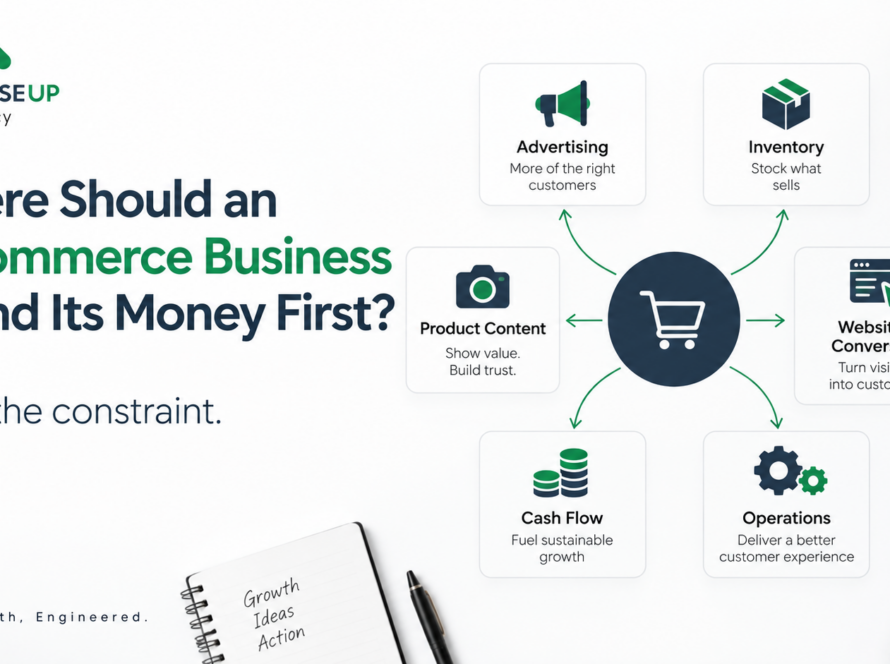
Before Spending More, Find the Bottleneck
This principle goes beyond the 4Ps.
Businesses have limited money.
That money might go toward:
- Advertising
- Product development
- Inventory
- Pricing changes
- Better product content
- Website improvements
- Technology
- Operations
- People
There is no rule saying marketing should always receive the next pound, dollar or dirham.
The right question is:
What is currently stopping the business from growing?
That is why our broader approach at AdvertiseUp is to diagnose the bottleneck before prescribing the solution.
If you want to explore this idea further, read:
Where Should an E-Commerce Business Spend Its Money First?
What Great Marketing Should Eventually Feel Like
The goal is not literally to create a Product that never needs Promotion.
Businesses still need awareness.
They need communication.
They need distribution.
Customers need to know the Product exists.
But the stronger the combination between Product, Price, Place and Promotion becomes, the less Promotion needs to compensate for fundamental weaknesses.
You stop trying to convince everybody.
Instead, you identify the right customer and communicate something that already makes sense to them.
Your message becomes less:
Please buy this.
And more:
The thing you were already looking for exists. You can find it here.
That is a much stronger marketing position.
The 4Ps Are Not Four Boxes in a Marketing Plan
Product.
Price.
Place.
Promotion.
Knowing the four words is easy.
Using them properly means understanding how they interact.
The Product needs to make sense for the customer.
The Price needs to make sense for the value and the business.
The Place needs to make sense for how and when customers want to buy.
And Promotion should help the right people discover and choose an offer that already has a reason to exist.
That is why great marketing starts long before the first ad goes live.
Before asking:
How should we advertise this?
Ask:
Does the combination make sense?
Sometimes the answer really is:
Run more ads.
But sometimes the better marketing decision is to improve the Product.
Change the Price.
Choose a better Place.
Fix the experience.
Strengthen the Offer.
Or simply understand the problem before spending another pound trying to promote it.
Not Sure Which Part of Your Marketing Is Actually Holding Growth Back?
Sometimes you know the business needs to grow, but you do not yet know whether the real issue is:
Product.
Pricing.
Marketing.
Advertising.
Your website.
Conversion.
Customer experience.
Or something else entirely.
That is exactly why AdvertiseUp starts with diagnosis.
A Free Business Growth Discovery Call helps us understand the situation, identify the likely bottleneck and determine what deserves attention first.
Internal CTA link: Link “Free Business Growth Discovery Call” to your existing Business Growth Consultation page.
The current consultation page confirms that the discovery call is free and is designed to understand the business, current marketing challenges and the most appropriate next step.
Frequently Asked Questions About the 4Ps of Marketing
What are the 4Ps of marketing?
The 4Ps of marketing are Product, Price, Place and Promotion. Together, they form a traditional marketing-mix framework for thinking about what a business sells, how it prices the offer, where customers buy it and how the business promotes it.
Why are the 4Ps important?
The 4Ps help businesses think beyond advertising alone. A strong marketing strategy considers whether the Product, Price, Place and Promotion support each other rather than treating Promotion as the solution to every sales problem.
What is an example of the 4Ps of marketing?
Cinema popcorn is a simple example. The Product fits the movie experience, the cinema provides the Place, the Price reflects the environment and convenience, and Promotion can include combos, upgrades and larger sizes.
Which of the 4Ps is most important?
There is no universally most important P. Their value comes from the way they work together. A strong Product can struggle in the wrong Place, while excellent Promotion may fail to compensate for poor Pricing or weak demand.
Is advertising part of the 4Ps?
Yes. Advertising is primarily part of Promotion, but marketing is broader than advertising. Product, Price and Place decisions can have just as much influence on whether Promotion ultimately generates profitable sales.
Should I increase my advertising budget if sales are low?
Not automatically. First understand where the problem occurs. If customers are not interested in the Product, reject the Price, struggle with the buying experience or drop out later in the funnel, sending more traffic may simply amplify the existing problem.
Written by Youssef Hedayat, Business Consultant and Founder of AdvertiseUp.
Youssef writes about business strategy, marketing, e-commerce, customer experience and growth, with a focus on identifying the real business problem before deciding where to invest or what to execute.