Where should an e-commerce business spend money first? It’s one of the questions I hear repeatedly from founders and store owners. Should the next investment go into advertising, inventory, product content, the website, hiring, or technology?
One of the questions I hear repeatedly from e-commerce business owners is:
“Where should I invest my money next?”
Should I increase my advertising budget?
Should I buy more inventory?
Do I need better product photography?
Should I rebuild my website?
Should I hire someone?
Should I invest in CRM, automation or AI?
My answer is usually:
I don’t know yet.
That might sound strange coming from a consultant, but I think confidently answering that question without first understanding the business would be irresponsible.
There is no universal percentage that tells every e-commerce company how much to spend on marketing, inventory, technology or people.
The right investment depends on one thing:
What is currently stopping the business from growing?
That is where I would start.
Don’t Start With the Budget. Start With the Bottleneck.
Imagine you have EGP 100,000 available to invest in your e-commerce business.
It is tempting to divide it immediately:
- some for advertising,
- some for inventory,
- some for content,
- some for the website,
- and maybe some for technology.
But two businesses generating exactly the same monthly revenue could need completely different things.
One might have excellent demand but constantly run out of stock.
Another might have too much stock and not enough customers.
A third might be attracting thousands of visitors but converting almost none of them.
Another might have profitable advertising but operations that cannot handle additional orders.
So before asking:
“Where should I spend my next EGP 100,000?”
I would ask:
“What is preventing the next EGP 100,000 from coming into the business?”
That is a very different question.
And usually, a much more useful one.
Scenario 1: Your Best Products Keep Selling Out
Imagine your advertising is profitable.
Customers want the product.
Your website converts.
But every few weeks, your strongest products are out of stock.
In that situation, increasing your advertising budget probably isn’t your first priority.
You already have demand.
You may have an inventory problem.
But even here, the answer isn’t simply:
“Buy as much stock as possible.”
Before restocking heavily, I would want to know:
How quickly is the product selling?
How long does your supplier take to restock it?
Is the demand consistent or seasonal?
What is the margin?
How much cash will be tied up in the order?
Are you confident the current demand will continue?
A product selling quickly does not automatically mean you should order twice as much.
Inventory is cash.
It is simply cash sitting on a shelf until somebody buys the product.
And if you buy the wrong inventory, that money can stay on the shelf for a very long time.
Scenario 2: You Have Traffic, but People Aren’t Buying
Now imagine the opposite.
You already have inventory.
Your advertising generates clicks.
Thousands of people visit the website.
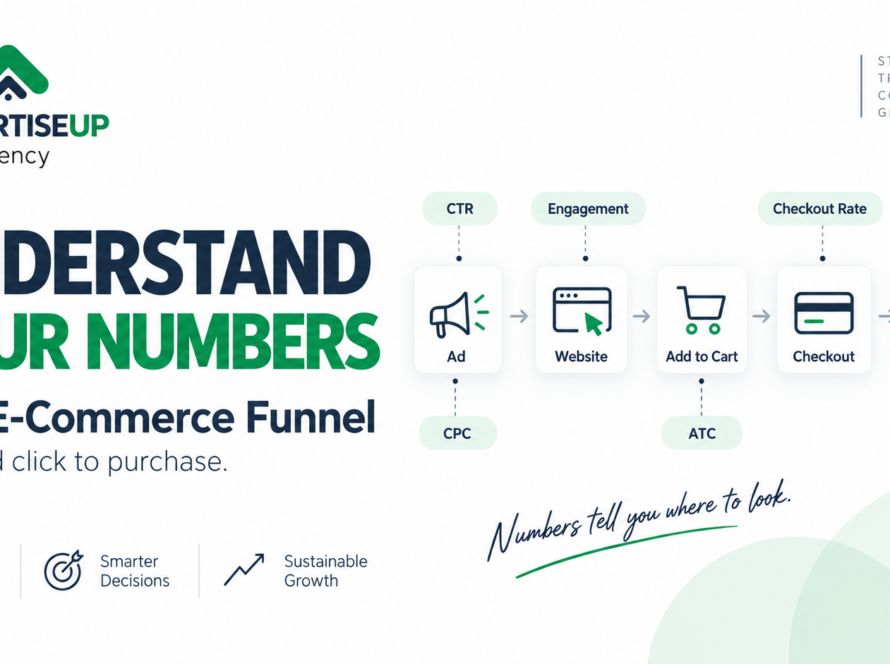
But the conversion rate is weak.
Increasing the advertising budget might simply mean paying to send more people into something that isn’t working.
The problem could be:
- the product,
- the price,
- the offer,
- poor product presentation,
- lack of trust,
- a weak mobile experience,
- shipping costs,
- checkout friction,
- or several of these at the same time.
This is why I’m always cautious when someone says:
“We just need more traffic.”
Maybe.
But sometimes more traffic simply makes the existing problem more expensive.
Before paying to bring another 10,000 visitors to the website, I want to know what happened to the previous 10,000.
Scenario 3: You Have a Good Product, but You’re Presenting It Badly
You might genuinely have a strong product.
The price might be competitive.
The website might technically work.
But when the customer arrives, the product simply doesn’t look convincing.
The photography is weak.
There is no useful video.
The benefits are unclear.
There are no reviews.
There is no UGC.
The customer cannot immediately understand why this product is different from the ten alternatives they have already seen.
In this situation, better product assets could create more value than immediately increasing advertising spend.
Advertising cannot communicate something the business itself has failed to explain.
Before asking:
“How do we reach more people?”
sometimes the better question is:
“If more people saw this product today, would they actually understand why they should buy it?”
Scenario 4: Everything Works. You Just Need More Customers.
There are also businesses where advertising genuinely is the bottleneck.
The product has demand.
The margin makes sense.
The website converts.
Inventory is available.
Operations can handle more orders.
Customer experience is good.
And acquiring another customer is profitable.
Now increasing your advertising investment becomes much more interesting.
The difference is important.
You are no longer asking advertising to fix the business.
You are using advertising to scale something that already works.
Those are two completely different situations.
Scenario 5: Sales Are Increasing, but You Never Have Enough Cash
This is one of the most misunderstood situations in e-commerce.
You look at the dashboard.
Revenue is growing.
Orders are increasing.
Everything appears positive.
But somehow, the business constantly feels short on cash.
Why?
Because:
Revenue is not cash.
Your money may currently be tied up in:
- inventory,
- advertising,
- COD or payment settlement cycles,
- returns,
- shipping and fulfilment,
- supplier payments,
- payroll,
- and the next restock.
Growth itself requires cash.
Imagine you sell more this month.
That sounds great.
But now you need more inventory.
The inventory requires cash.
Then you need advertising to sell the new inventory.
That also requires cash.
Meanwhile, some of the money from the previous orders might not even have reached your bank account yet.
So yes:
It is completely possible for sales to grow while the company becomes more uncomfortable financially.
In that situation, the right answer might not be:
“Spend more.”
The priority could be improving how cash moves through the business.
Scenario 6: Marketing Works, but Your Operation Is Breaking
This is another situation I have seen businesses discover only after they start growing.
The marketing works.
Orders increase.
And then everything behind the marketing starts struggling.
Customer service cannot keep up.
Orders are delayed.
Inventory becomes inaccurate.
Returns become difficult to track.
Employees start making mistakes.
Customers become frustrated.
At this point, increasing advertising could actually make the business worse.
You may need to invest in:
- people,
- fulfilment,
- operational processes,
- inventory systems,
- automation,
- customer service,
- or technology.
One of the important things about growth is that it keeps moving the bottleneck.
The problem you had when the business was doing EGP 200,000 per month may not be the problem you have at EGP 500,000.
And the problem at EGP 500,000 may completely change again at EGP 1 million.
This is why copying another company’s spending formula rarely works.
You are solving a different problem.
Not sure what your business needs next?
Find the bottleneck before you spend more.
ThinkUp helps business owners identify what is actually holding growth back, prioritize the right next move, and avoid investing in the wrong problem. Learn more about the consultancy, or start with a free business growth consultation.
So What Should an E-Commerce Business Invest In First?
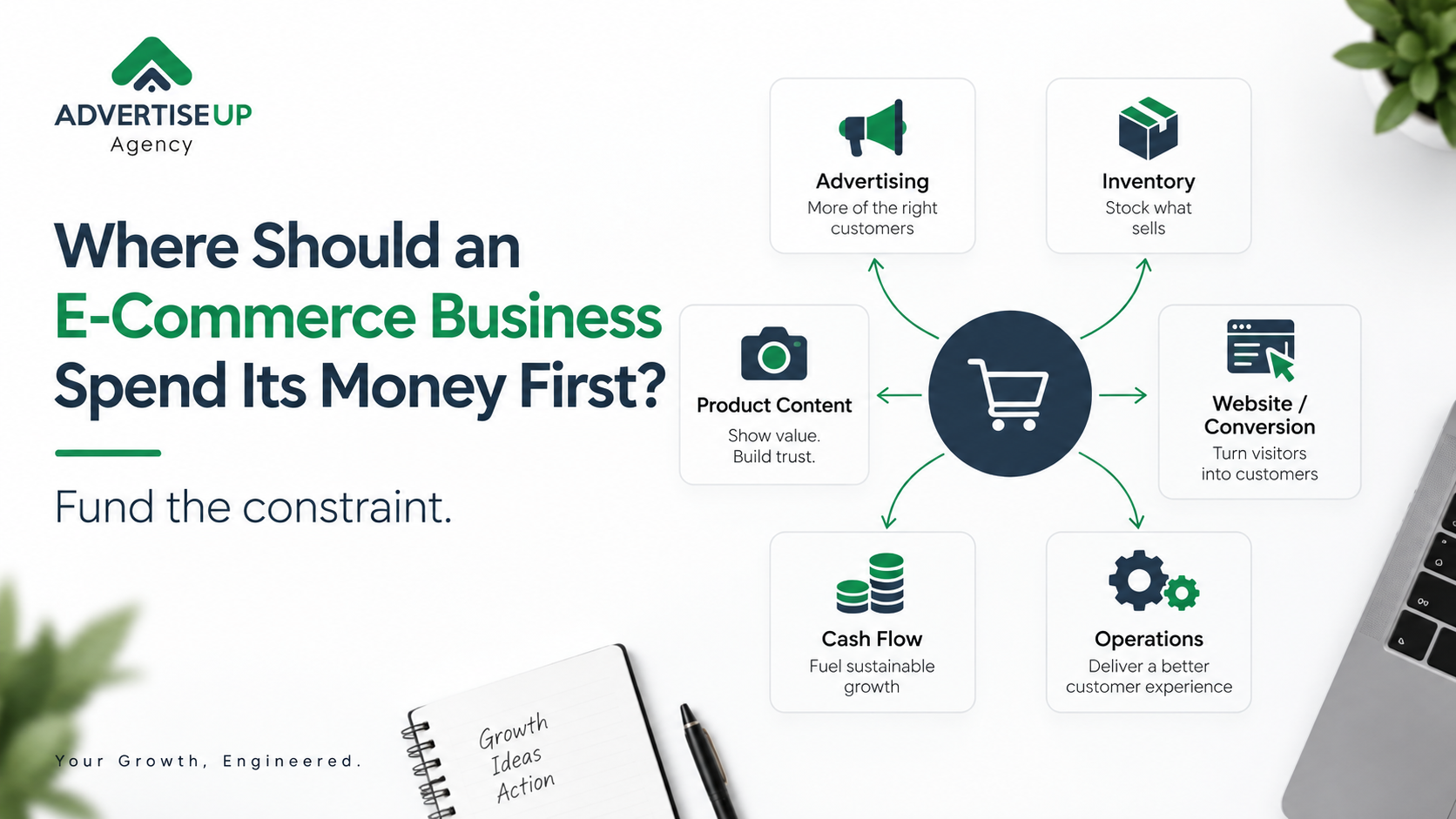
I generally want to understand six things.
1. Is there real demand?
Do people actually want the product?
If the answer is no, putting more money behind it is unlikely to solve the fundamental problem.
2. Do the economics make sense?
Are you actually making enough money when you sell?
Revenue alone does not answer this.
Look at margin, acquisition cost, fulfilment, discounts, returns and the other costs required to generate the sale.
3. Can the customer successfully buy?
Look at:
the offer,
the price,
the product content,
the website,
trust,
shipping,
and checkout.
If people want the product but cannot comfortably complete the purchase, acquisition is not necessarily the priority.
4. Can you fulfil more demand?
Do you have enough inventory?
Can operations handle additional orders?
Can customer service cope?
Can you maintain the customer experience?
5. Can you finance the growth?
More sales usually require more working capital.
You may need to buy stock and spend money before the revenue from those sales reaches you.
Growth needs financing.
6. Do you simply need more demand?
If the previous pieces are healthy, then marketing and acquisition may genuinely be the biggest opportunity.
At that point, spending more to reach more of the right customers can make sense.
Fund the Constraint
If there is one idea I would want an e-commerce owner to take from this article, it is this:
Fund the constraint.
If inventory is stopping growth, fix inventory.
If conversion is stopping growth, fix conversion.
If customers don’t understand the product, improve the product assets.
If cash flow is preventing you from restocking, address the cash-flow problem.
If operations are collapsing, fix operations.
And if the machine is working but simply needs more customers, then increase acquisition.
The priority is not determined by what is fashionable.
It is determined by what the business needs next.
Marketing Isn’t Automatically the Best Investment
I own a company that provides marketing, advertising, technology and business consultancy services.
It would be commercially convenient for me to tell every business owner:
“Spend more on marketing.”
But sometimes that would be terrible advice.
Sometimes you need better inventory planning.
Sometimes you need better product photography.
Sometimes you need to reconsider your pricing.
Sometimes the website genuinely needs work.
Sometimes the operation needs another employee.
Sometimes technology can remove a major bottleneck.
And sometimes the best recommendation is:
Don’t spend the money yet.
Understand the problem first.
Instead of Asking “Where Should I Spend?”, Ask This
The next time you have money available to invest in your business, don’t immediately ask:
“Should I spend it on advertising, inventory or technology?”
Ask:
“What is currently preventing this business from reaching the next stage?”
Once you understand that, the investment decision becomes much easier.
Business growth isn’t about investing in everything.
It is about putting money into the right problem, at the right time.
That is the difference between simply spending money and actually using money to grow.
Frequently Asked Questions
Should an e-commerce business spend more on inventory or advertising?
It depends on the current bottleneck. If demand is strong but products keep selling out, inventory may be the priority. If inventory is healthy and the business can profitably serve more customers, acquisition may deserve more investment.
How much of revenue should an e-commerce business spend on marketing?
There is no percentage that works for every business. Marketing spend should be evaluated alongside gross margin, customer acquisition cost, lifetime value, cash flow, inventory availability, conversion rate and growth objectives.
Should I increase my advertising budget when sales are growing?
Not automatically. First determine whether additional sales remain profitable, whether enough stock is available, whether operations can support additional demand and whether the company has enough cash to finance further growth.
What is the biggest mistake businesses make when deciding where to invest?
One of the biggest mistakes is investing based on assumptions instead of identifying the current bottleneck. Businesses often spend more on advertising, inventory or technology because they feel they should, rather than because that area is actually limiting growth.